tsm::task_context Class Reference
#include <coroutine.h>
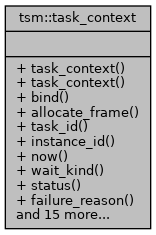
Collaboration diagram for tsm::task_context:
Public Types | |
| using | predicate_fn = bool(*)(void const *) noexcept |
| using | wake_fn = void(*)(void *, std::size_t) noexcept |
| using | sleep_fn = bool(*)(void *, std::size_t, tsm::tick_rep) noexcept |
| using | cancel_sleep_fn = void(*)(void *, std::size_t) noexcept |
Public Member Functions | |
| task_context ()=default | |
| task_context (static_coroutine_arena< 1U > *, std::size_t, std::size_t, std::size_t)=delete | |
| template<std::size_t Bytes> | |
| void | bind (static_coroutine_arena< Bytes > &arena, std::size_t task_id, std::size_t instance_id, std::size_t frame_limit, void *scheduler, wake_fn wake, sleep_fn sleep, cancel_sleep_fn cancel_sleep) noexcept |
| void * | allocate_frame (std::size_t bytes, std::size_t alignment) noexcept |
| std::size_t | task_id () const noexcept |
| std::size_t | instance_id () const noexcept |
| tsm::tick_rep | now () const noexcept |
| task_wait_kind | wait_kind () const noexcept |
| task_status | status () const noexcept |
| task_failure_reason | failure_reason () const noexcept |
| std::uint32_t | generation () const noexcept |
| void | set_now (tsm::tick_rep now) noexcept |
| void | mark_ready () noexcept |
| void | prepare_start () noexcept |
| void | mark_running () noexcept |
| void | sleep_for (tsm::tick_rep ticks) noexcept |
| void | cancel_sleep () noexcept |
| template<typename Object , typename Predicate > | |
| void | wait_until (Object const &object, Predicate predicate) noexcept |
| bool | ready_to_resume () const noexcept |
| bool | predicate_ready () const noexcept |
| void | mark_completed () noexcept |
| void | mark_failed (task_failure_reason reason=task_failure_reason::unhandled_exception) noexcept |
| void | cancel () noexcept |
| void | request_wake () noexcept |
| void | clear_queued () noexcept |
Detailed Description
Runtime state visible to awaitables created inside a task.
Awaitables do not talk to an executor directly. They mark this context as ready, sleeping, failed, or waiting on a predicate; the scheduler then uses the context to decide which coroutine can run next. This keeps awaitable types small and lets the executor enforce fixed queue and timer capacities.
Member Typedef Documentation
◆ cancel_sleep_fn
| using tsm::task_context::cancel_sleep_fn = void (*)(void*, std::size_t) noexcept |
◆ predicate_fn
| using tsm::task_context::predicate_fn = bool (*)(void const*) noexcept |
◆ sleep_fn
| using tsm::task_context::sleep_fn = bool (*)(void*, std::size_t, tsm::tick_rep) noexcept |
◆ wake_fn
| using tsm::task_context::wake_fn = void (*)(void*, std::size_t) noexcept |
Constructor & Destructor Documentation
◆ task_context() [1/2]
|
default |
◆ task_context() [2/2]
|
delete |
Member Function Documentation
◆ allocate_frame()
|
inlinenoexcept |
◆ bind()
template<std::size_t Bytes>
|
inlinenoexcept |
◆ cancel()
|
inlinenoexcept |
◆ cancel_sleep()
|
inlinenoexcept |
◆ clear_queued()
|
inlinenoexcept |
◆ failure_reason()
|
inlinenoexcept |
◆ generation()
|
inlinenoexcept |
◆ instance_id()
|
inlinenoexcept |
◆ mark_completed()
|
inlinenoexcept |
◆ mark_failed()
|
inlinenoexcept |
◆ mark_ready()
|
inlinenoexcept |
◆ mark_running()
|
inlinenoexcept |
◆ now()
|
inlinenoexcept |
◆ predicate_ready()
|
inlinenoexcept |
◆ prepare_start()
|
inlinenoexcept |
◆ ready_to_resume()
|
inlinenoexcept |
◆ request_wake()
|
inlinenoexcept |
◆ set_now()
|
inlinenoexcept |
◆ sleep_for()
|
inlinenoexcept |
◆ status()
|
inlinenoexcept |
◆ task_id()
|
inlinenoexcept |
◆ wait_kind()
|
inlinenoexcept |
◆ wait_until()
template<typename Object , typename Predicate >
|
inlinenoexcept |
The documentation for this class was generated from the following file:
- include/tsm/runtime/coroutine.h