tsm::core::static_path< Capacity > Struct Template Reference
#include <core_algorithms.h>
Collaboration diagram for tsm::core::static_path< Capacity >:
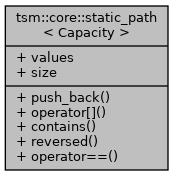
Public Member Functions | |
| constexpr void | push_back (std::uint16_t value) |
| constexpr std::uint16_t | operator[] (std::size_t index) const |
| constexpr bool | contains (std::uint16_t value) const |
| constexpr static_path | reversed () const |
| constexpr bool | operator== (static_path const &other) const |
Public Attributes | |
| std::array< std::uint16_t, Capacity > | values {} |
| std::size_t | size {} |
Detailed Description
template<std::size_t Capacity>
struct tsm::core::static_path< Capacity >
A path is an ordered sequence of states through the hierarchy.
Examples: root-to-leaf: '(Root Motor Idle) leaf-to-root: '(Idle Motor Root) exit-list: '(Idle Motor) entry-list: '(Drive Enabled)
This implementation stores the path as a fixed-capacity sequence of numeric state IDs. The capacity is usually the number of states, which is a conservative maximum depth for a valid tree-shaped hierarchy.
(define-type StateId UInt16) (define-type (Path N) (record (values (Array StateId N)) (size Nat)))
Member Function Documentation
◆ contains()
template<std::size_t Capacity>
|
inlineconstexpr |
◆ operator==()
template<std::size_t Capacity>
|
inlineconstexpr |
◆ operator[]()
template<std::size_t Capacity>
|
inlineconstexpr |
◆ push_back()
template<std::size_t Capacity>
|
inlineconstexpr |
◆ reversed()
template<std::size_t Capacity>
|
inlineconstexpr |
Member Data Documentation
◆ size
template<std::size_t Capacity>
| std::size_t tsm::core::static_path< Capacity >::size {} |
◆ values
template<std::size_t Capacity>
| std::array<std::uint16_t, Capacity> tsm::core::static_path< Capacity >::values {} |
The documentation for this struct was generated from the following file:
- include/tsm/core_algorithms.h